The Invisible College: Seeking utopia in chaos
Presented to The Victorian Masonic Lodge of Research on Friday 28 August 2026
Introduction
For centuries, the practice of Hermetic alchemy represented the pinnacle of human inquiry into the material and spiritual architecture of the cosmos. Between the sixteenth-to-seventeenth centuries, thousands of writings appeared dedicated to this art of transmutation. Alchemy was an ambitious endeavour that covered disciplines that we would today consider independent disciplines. Metallurgy, natural philosophy, medicine, chemistry, engineering, and even theology found their expression in this curious art. Depending upon the alchemist in question, transmutation included not just transmuting base metals into gold, but also encompassed the transmutation of man and the production of healing panaceas. Yet despite this, alchemy was by no means uniform either in practice nor in doctrine.
By the mid-seventeenth century, this tradition had begun to reach its limit. Its expression was pushing against the boundary of possibilities; promises that had seemed endless during the middle-ages were now beginning to deteriorate under the weight of the art’s own intellectual fragmentation. Whilst alchemists of the medieval and early-modern era had achieved some remarkable discoveries in metallurgy, medicine, and chemical distillation, their contemporary seventeenth century practitioners found themselves trapped in a retrogressive cycle, tethered to a spirit of inquiry that was fading into a siloed artisan model. Alchemists often worked alone or in small groups. Secrets were passed on from Master to Apprentice. To make matters worse, much of the intellectual discourse of the alchemists was deliberately encoded, intentionally obscured, and fundamentally anti-cooperative.
These practitioners were frequently individuals of extraordinary intellect and deep erudition. If we take the time to look at the famous alchemists of note in isolation, we will recognise that they were incredibly talented people. They were indeed the brightest minds of their day. But a scientific paradigm shift required from these great minds something that could not be gained in private master-apprentice-style workshops or secretive initiatory relationships.
In contrast, the modern scientific model that exists today necessitates open collaboration, standardised nomenclature, and reproducible methodology as foundational pillars of scientific research. Contemporary physicists, or chemists, may hold personal, political, or religious philosophies that diverge radically from those of their peers; nevertheless, provided that they adhere to the rigorous empirical standards, engage with peer-reviewed literature, and communicate thorough a shared vocabulary, they participate in a unified discipline. This means that today, we have the luxury of being able to meaningfully and accurately generalise by stating things such as, “Physicists believe X” or “Chemists affirm Y”.
But alchemy never achieved this unity of consensus. It is simply impossible to state that “Alchemists believed X” as alchemy as a tradition was so multi-faceted and divergent. It would not be so bad if the consequences brought about by this stagnation only affected a small esoteric niche. But as alchemy was studied by the brightest minds of the day, we find that science, especially chemistry and medicine, were now being restrained; shackled to the authoritarian dogmas of Aristotle and Galen.
To bridge the chasm between the last sorcerer-alchemists and the first true modern scientists, a new organisational model was required: a framework capable of cultivating intellectual unity amidst the sociopolitical chaos that was occurring in Western Europe.
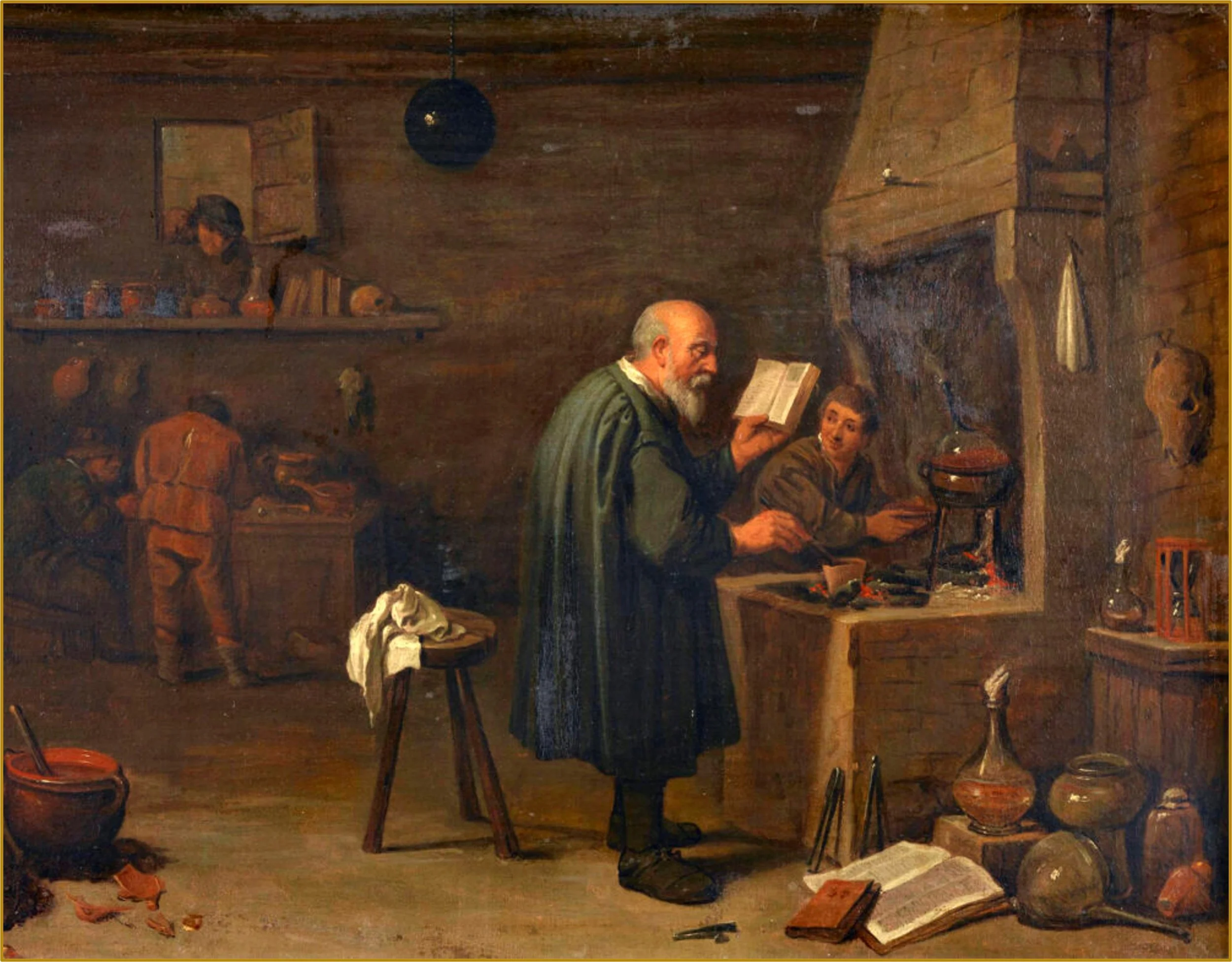
Figure 1: The Bald Alchemist by David Teniers (1610-1690). In this painting, a Master can be see with his attentive Apprentice, working over a crucible. This was the reality of many English alchemists at this time.
Twilight of the Alchemist
Let us not make ourselves feel superior and assert that the failure of alchemy was one of superstition or fantasy. The structural failure of alchemy was not a failure of intellect. These were smart people. Simply, it was a failure of methodology and social architecture.
Alchemists loved to use metaphors and allegories. Dragons devouring tails; lions swallowing suns; marriages between kings and queens. And whilst these symbolic vocabularies might have been imbued with psychological and esoteric meaning, they were ill-suited for the systematic transmission of empirical data. Two alchemists working in adjacent towns might discover the exact same chemical reactions yet describe their observations using radically different symbolic vocabularies ensuring that neither could build upon the other’s labour.
Add to this the socio-religious environment of the late-sixteenth and early-seventeenth centuries which added in the threat of persecution by religious authorities, coupled with the real danger of counterfeiters (or puffers) who diluted the reputation of any genuine alchemist with dangerous snake-oils, and the result is the further siloing of legitimate natural philosophers into deeper obscurity. Whilst the master-apprentice model was effective for preserving trades, it was proving catastrophic for broad scientific advancement. And if a Master were to die before imparting his Arcanum to a worthy disciple, a lifetime of experimental knowledge might just be lost forever.
The intellectual landscape of early-seventeenth century Europe was curiously paradoxical. Never before had there been so many brilliant minds investigating the natural world. Yet, rarely had their efforts been so tragically fragmented. The classical authorities maintained a dogmatic hold over university curricula. University faculties engaged in endless scholastic debates, preferring to dissect Aristotle’s writings on physics and cosmology or Galen’s takes on medicine, rather than interrogating nature herself.
The hearth of the alchemist was growing cold. What was needed was an intellectual reformation. Fortunately, discussion of a General Reformation of the Whole Wide World[1] was already taking place.
Setting the Scene
Before we can properly appreciate the establishment of The Invisible College and how it blossomed into The Royal Society, we must first set the scene and come to understand the landscape that gave rise to this institution.
The Rosicrucian Reformation
Many authors when writing about Masonic influences surrounding The Royal Society love to tease the reader by mentioning the mysterious Rosicrucian movement. But rarely is this influence given any adequate expression except by a waving paragraph or two towards some unusual anonymous texts that had been in circulation in Germany and France. But this influence is far greater than many imagine and it is truly deserving of expansion. It is the key to not just understanding both The Invisible College and Freemasonry, but it also is the key to understanding the state of human progress in the western world.
In fact, the adjective invisible when discussing The Invisible College carries with it a direct historical connection with the aforementioned Rosicrucian movement, which had arisen in Germany and France in the early-seventeenth century via the circulation of multiple anonymously written allegorical texts which proclaimed the commencement of a new age being heralded by the mysterious Rosicrucian Brotherhood.
Propaganda purportedly written by this invisible brotherhood took on many forms, but they all seemed to share similar ideas and values[2]. Over time, such sentiments would be echoed by individuals who were no doubt influenced by these sentiments and who had decided to capitalise on the momentum by developing additional materials of their own. So even though we may have ended up with dozens of such booklets, pamphlets, and posters separated by both time and geography, they all tended to share similar ideas. So similar that even today, we are still not sure just how many authors there actually were.
The complete history, philosophy, and doctrines of this movement is well beyond this paper. But it is sufficient to state that, starting in Germany in the early 1600’s, a group of learned scholars, expressing themselves as the Rosicrucian Brotherhood, had begun to state publicly what many of the intelligentsia were in fact saying privately, but through either fear of retribution, persecution, or ostracism, were simply unable to express in any identifiable manner.
What were these ideas? There were several. The Catholic Church was corrupt and cared more for prestige than the teachings of Christ. The reformation had a good intent, but was a failed endeavour. Islamic expansionism posed a threat to the western world. Fake alchemists were making a mockery of a true divine art. Traditional societal and cultural values were crumbling with an onset of blasphemous societal standards. Education had lost its innovative spirit of inquiry and was now focused perpetuating ancient dogmas.
But all was not lost, for the Rosicrucian writers offered a hopeful vision for the future. A coming return to a true Christianity was fast approaching. The Rosicrucians had discerned this return by reading both the bodies in the heavens and the actions of mankind. This progress was not so much being initiated by the Rosicrucians, but rather, the Rosicrucians were simply acting as assistants to a pre-existent natural divine order. They claimed to be the guardians of an ancient wisdom, gathered since the dawn of humanity, and they were finally ready to reveal this to mankind.
Three decades after the arrival of the Rosicrucian documents in Germany, these sentiments were being shared in England, who just like Germany, was in the throes of a terrible clash of culture, politics, and religion.
By the time of The Invisible College, this Rosicrucian ideal had been championed in England by such eminent thinkers as Samuel Hartlib and his Pansophic circle, Elias Ashmole who had amassed a treasury of Rosicrucian works, and Robert Fludd who wrote extensively upon Rosicrucian doctrines.
The Invisible College was, in many respects, the practical realisation of this Rosicrucian vision, stripping away its apocalyptic excesses and anchoring its reformist zeal into an empirical design.
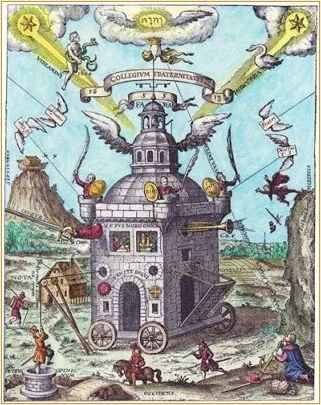
Figure 2: This representation of the Fraternity of the Rosy Cross appeared in a Rosicrucian source work of 1618 titled, 'The Mirror of Wisdom of the Rosy Cross', published by the German alchemist Theophilus Schweighardt Constantiens.
The English Civil Wars
And of course, the second major influence upon the establishment of The Invisible College was the English Civil Wars which were tearing apart the British Isles between 1642 and 1651. This was a catastrophic conflict that pitted Royalists (Cavaliers), supporting the divine right of King Charles I, against Parliamentarians (Roundheads), advocating for parliamentary supremacy and Puritan religious reform.
The war resulted in the execution of Charles I in 1649, the collapse of the Church of England's authority, and the rise of Oliver Cromwell’s Commonwealth and Protectorate, initiating a decade of intense religious sectarianism and political purges that fractured the nation's social fabric. Following Cromwell’s death in 1658, his son Richard briefly attempted to maintain power, but escalating political instability and a fracturing army soon forced his resignation and ended the Commonwealth. Recognising the urgent need to restore order, General George Monck engineered the recall of Parliament, which opened negotiations with the exiled heir (who had up to this point been living a rock’n’roll hedonist lifestyle in France and Netherlands), leading Charles II to issue the Declaration of Breda, promising a general amnesty and religious tolerance, and return to reclaim the throne during the Restoration of May 1660.
It was only after this political dust had settled that the informal network of natural philosophers known as The Invisible College emerged into the open, constituting themselves on November 28 1660, and receiving royal patronage to be officially chartered as the Royal Society of London in July 15 1662.
Up until this stability was reached, open discussion of philosophy, theology, or statecraft carried immense risk. Imprisonment, execution, and confiscation of estates were commonplace. For men of intellect (many of whom had seen their libraries destroyed, their offices stripped, and/or their comrades killed over the previous years) there existed a desperate need for a sanctuary where intellectual inquiry could continue without being contaminated by the fanatical hatreds of the day. In short, an educational reformation.
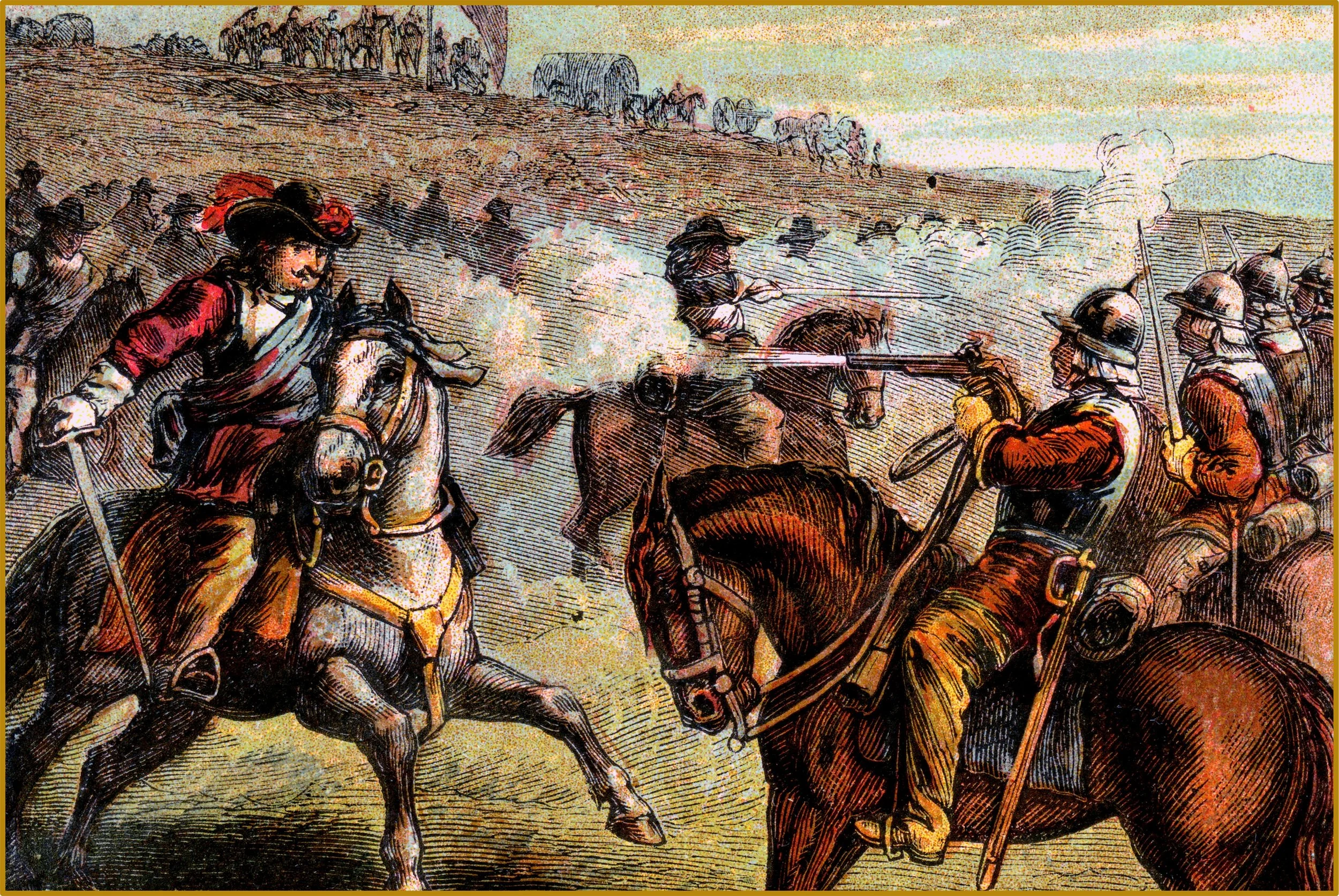
Figure 3: The intense sectarian violence of the Engish Civil Wars led to an urgent demand among intellectual elites for a neutral sanctuary where inquiry could occur without fear of persecution.
The Great Instauration: The Invisible Hand behind The Invisible College
I shall only mention one great Man, who had the true Imagination of the whole Extent of this Enterprise, as it is now set on foot; and that is, the Lord Bacon; in whose Books there are every where scattered the best Arguments, that can be produced for the Defence of experimental Philosophy, and the best Directions, that are needful to promote it: All which he has already adorn'd with so much Art; that if my Desires could have prevailed with some excellent Friends of mine, who engag'd me to this Work, there should have been no other Preface to the History of the Royal Society, but some of his Writings. (Sprat, 1667)
The conceptual catalyst for this reformation came partially in the form of Sir Francis Bacon (1561-1626), Viscount St. Alban. When exploring the foundation of The Invisible College (which would later become The Royal Society), Bacon’s hidden hand is ever present. While he was not present at its foundation, having died two decades prior, those that were instrumental in The Invisible College professed the greatness of his philosophy and proclaimed him as the philosophical founder of the movement itself.
Bacon is an enigma. Mystery surrounds him like iron to a magnet. Many esoteric authors proclaim him a secret Rosicrucian Master. Some see him as the true author behind Shakespeare. Others posit him as the hidden hand behind the initial Rosicrucian source work, the Fama Fraternitatis.
But his acclaim and legend extend beyond the dark niche corners of esotericism. Even within mainstream academia, posterity honours Bacon as a pioneer of modern science. And whilst he was the pioneer of the scientific method, he was not a particularly adept experimentalist. In fact, his practical limitations were famously demonstrated in his final experiment in the spring of 1626. In attempting to test the effects of refrigeration on the preservation of flesh, he stuffed a freshly slaughtered chicken with snow, caught a severe chill, and died shortly thereafter, thus earning him the irreverent title of the “Patron Saint of Frozen Chickens (Lomas, 2012, p. 66).”
Yet, what Bacon lacked in laboratory dexterity, he more than made up for in vision. He recognised that the state of knowledge in the world required a systemic renewal. This educational reformation he would call a Great Instauration (Latin: Instauratio Magna).
Bacon identified the primary impediment to human knowledge as the uncritical reliance on deductive logic. For centuries, scholasticism had operated by taking accepted dogmas (primarily derived from Aristotelian philosophy and Church doctrine) and used deductive reasoning to force observed physical facts into pre-conceived intellectual boxes.
Bacon proposed a radical reversal in the form of inductive reasoning. He asserted that the natural philosopher must approach creation as a blank slate (Latin: tabula rasa). He would say that the scientist must strip away the Idols of the Mind (Bacon, 1902, pp. 19-22) and instead, the discovery of new facts should proceed from the ground up. In his Novum Organum, we see the foundation of what would be formalised as the Scientific Method. Making observations, asking questions, conducting research, forming hypotheses, performing experiments, and sharing and subjecting results to a “scrupulous and severe examination of particulars (Sprat, 1667).”
This philosophy found its ultimate expression in Bacon’s posthumous utopian fable, The New Atlantis (1627). In this work, sailors discover the isolated island of Bensalem, a society governed by a state-sponsored research institution called Salomon’s House (or the College of the Six Days’ Works). This research institution would bare a curious similarity to The Royal Society.
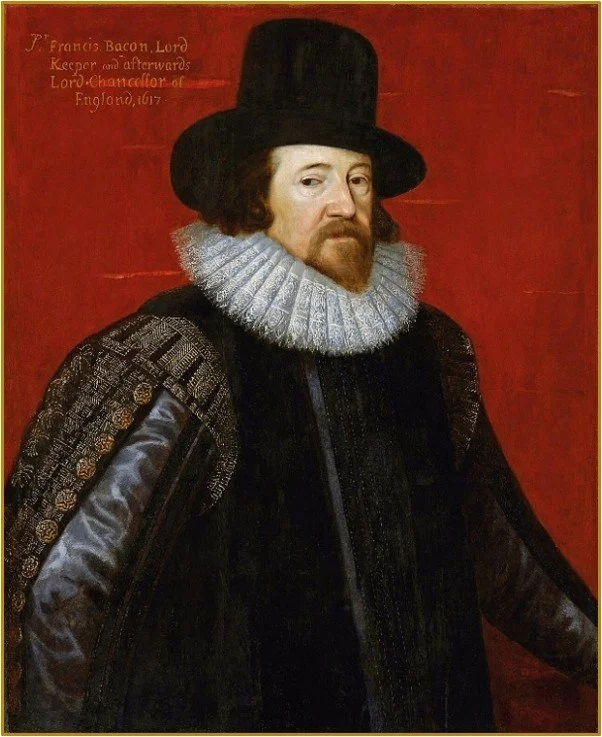
Figure 4: The enigmatic Sir Francis Bacon was the philosophical founder of The Invisible College. In The New Atlantis (1627), he envisioned a state-sponsored institution called, Salomon’s House which appears as a prototype of The Royal Society.
A Summary of The New Atlantis
The New Atlantis begins with a crew of European sailors who set sail from Peru toward China and Japan. After encountering contrary winds in the vast wilderness of the South Sea, their provisions run short, leaving them lost and preparing for death. They pray to God for salvation, and the following evening they discover an unknown island. Upon attempting to land, local officials approach them in boats with scrolls written in ancient Hebrew, Ancient Greek, Latin, and Spanish, forbidding them to land unless they are sick or in need of provisions. After declaring themselves Christians and swearing they are not pirates, the crew is granted entry and housed in the city of Bensalem within the spacious, Strangers' House.
While recovering in the Strangers' House, the crew learns about the island's unique history and culture. They learn that Christianity was miraculously brought to Bensalem roughly twenty years after Christ’s Ascension via a glowing pillar of light over the sea and a chest containing the Old and New Testaments alongside a letter from St. Bartholomew. The crew also learns about King Solamona, who ruled nineteen hundred years prior and established the island’s laws of secrecy and self-sufficiency. King Solamona instituted a policy of remaining invisible from the rest of the world while sending out secret agents across the globe every twelve years. The role of these secret agents was to collect knowledge, books, and scientific advancements which they did whilst disguised as regular citizens of the nations they visited[3].
The climax of the narrative occurs with the arrival of one of the Fathers of Salomon's House, the state-funded scientific institution founded by King Solamona. The Father of Salomon's House enters the city with great magnificence and ceremony, granting a private audience to the narrator to explain the organisation and mission of their society. He outlines the core objective of Salomon’s House: “the knowledge of Causes, and secret motions of things; and the enlarging of the bounds of Human Empire, to the effecting of all things possible (Bacon, 1626/2020, p. 33)”. He then provides a comprehensive description of the institution's state-of-the-art facilities, which include deep caves for refrigeration and preservation, high towers for meteorological studies, vast orchards and gardens for biological experimentation, and advanced laboratories for chemistry, mechanics, optics, and medicine.
Finally, the Father explains how the research duties are systematically divided among various groups of scholars, such as Merchants of Light who gather information abroad, Depredators who collect experiments from books, Pioneers who conduct new experiments, and Interpreters of Nature who formalise observations into general axioms and inventions. After bestowing a monetary gift to the narrator, the Father grants him permission to publish the account of Bensalem and Salomon's House for the enlightenment and benefit of foreign nations.
Many authors have attempted to draw a connection between Sir Francis Bacon and the Masonic and Rosicrucian movements. And certainly, within this story we can see some literary parallels between the themes presented in The New Atlantis and the ideals of the Rosicrucian and Masonic movements.
This story directly inspired the founders of The Invisible College and served as the foundational model for The Royal Society.
The intellectual vision of Bacon’s Salomon’s House might have remained a literary curiosity had it not been forged in the violent crucible of seventeenth-century English history. Just like the Fama Fraternitatis that preceded it, it had captured lightning in a bottle.
The Invisible College
At its most practical level, the college was invisible because it possessed no permanent physical campus, no official charter, and no state funding during the Interregnum[4]. It was an un-incorporated, fluid network of scholars who gathered in private residences, taverns, coffeehouses, and college rooms, most notably Wadham College in Oxford, and Gresham College in London. They were a community of minds bound by shared goals. In other words, it was not a building made of stone.
The first use of the phrase The Invisible College in relation to this group appears in the letters of Robert Boyle written in late 1646 and early 1647. Writing to his tutor, Isaac Marcombes, in October 1646, Boyle mentions his studies in natural philosophy:
“THE other humane studies I apply myself to, are natural philosophy, the mechanics, and husbandry, according to the principles of our new philosophical college, that values no knowledge, but as it hath a tendency to use. And therefore I shall make it one of my suits to you, that you would take the pains to enquire a little more thoroughly into the ways of husbandry, &c. practised in your parts; and when you intend for England, to bring along with you what good receipts or choice books of any of these subjects you can procure; which will make you extremely welcome to our invisible college.” (Hunter, Clericuzio, & Principe, 2016, p. 42)
In a later letter written to his academic companion Francis Tallents dated February 20 1647, Boyle furnishes us with a better understanding of just what is meant by The Invisible College whilst expressing his immense respect, admiration, and affection for its members, whom he refers to as corner-stones,
The best on’t is, that the corner-stones of the invisible, or (as they term themselves) the philosophical college, do now and then honour me with their company […] men of so capacious and searching spirits, that school-philosophy is but the lowest region of their knowledge; and yet, though ambitious to lead the way to any generous design, of so humble and teachable a genius, as they disdain not to be directed to the meanest, so he can but plead reason for his opinion; persons, that endeavour to put narrow-mindedness out of countenance, by the practice of so extensive a charity, that it reaches unto every thing called man, and nothing less than an universal good-will can content it. And indeed they are so apprehensive of the want of good employment, that they take the whole body of mankind for their care. (Hunter, Clericuzio, & Principe, 2016, pp. 46-47)
So, just who were these corner-stones whose knowledge far exceeded regular academia; and yet were so incredibly humble as to have as their central focus and responsibility, the well-being of all mankind.
The Men of the Invisible College
Boyle’s explicit use of terms such as corner-stones in connection with this invisible body is quite revealing. During the mid-seventeenth century, operative masonry was undergoing an evolutionary transformation into speculative Freemasonry. It is possible that early accepted Masons, such as Moray and Ashmole, were bringing the moral, philosophical, and architectural symbolism of the stonecutter’s craft into their intellectual circles. The concept of an invisible lodge or spiritual building (a temple not built with hands and constructed from living stones) would be familiar to Freemasons and one does wonder whether he was using the term specifically to both conceal and reveal his underlying values.
The group of individuals who formed the core of The Invisible College, and who would subsequently establish the Royal Society in 1660, represented an extraordinary cross-section of seventeenth century English society. They were a “strange political mix (Lomas, 2012, p. 25)” of passionate Royalists and committed Parliamentarians, High Church Anglicans, Puritans, and Hermetic esotericists who, under ordinary social circumstances, would have been mortal enemies.
Let us take a look at just some of the known members of The Invisible College.
The Parliamentarians
Dr. John Wilkins (1614-1672)
A man of exceptional political agility and intellectual breadth, Wilkins served as Warden of Wadham College, Oxford, during the Interregnum and later as Master of Trinity College, Cambridge. Crucially, he was the brother-in-law of Oliver Cromwell, having married Cromwell’s sister, Robina. Despite this close tie to the Protectorate, Wilkins was celebrated for his tolerance and fairness, using his position at Oxford to shelter Royalist scholars and provide a safe physical meeting space for natural philosophers. He was a polymath who wrote on cryptography, mechanical inventions, and the possibility of space travel (The Discovery of a World in the Moone).
Robert Boyle (1627-1691)
The youngest son of the 1st Earl of Cork, Boyle was a wealthy natural philosopher, alchemist, and theologian who is widely regarded today as the father of modern chemistry. It is Boyle who explicitly popularised the term The Invisible College in his personal correspondence between 1646-1647. Boyle was deeply religious. He also possessed a legendary aversion to taking oaths, a trait that later led him to decline the presidency of The Royal Society, which position required the swearing of an oath. His work on gas laws (Boyle’s Law) is still taught to Chemistry students today.
Dr. William Petty (1623-1687)
A Parliamentarian who served as Physician-General to Cromwell’s army in Ireland, Petty was an economic genius, survey pioneer, and inventor. He created the Down Survey of Ireland, invented early forms of demography and statistical analysis (which he termed Political Arithmetick), and designed innovative marine vessels, including early twin-hulled catamarans.
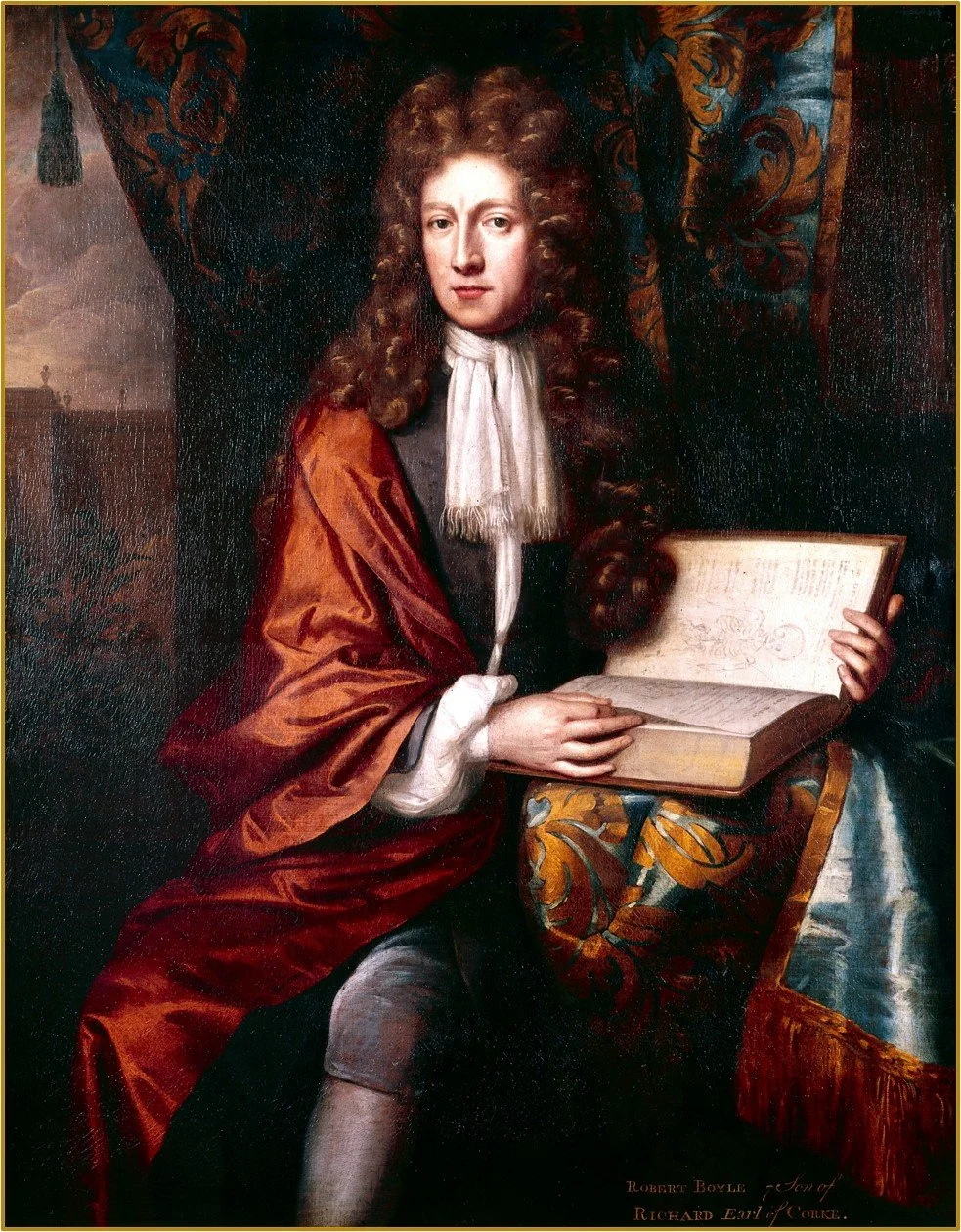
Figure 5: Within the correspondence of Robert Boyle (1646–1647) we learn of the exceedingly humble and charitable 'corner-stones' that formed The Invisible College.
The Royalists
Sir Robert Moray (1609-1673)
Sir Robert Moray was a quintessential Renaissance man. He was a skilled diplomat, soldier, chemical experimenter, natural philosopher, and trained spy for the Royalist cause. On May 20 1641, while serving with the Scottish army at Newcastle, Moray was initiated into Freemasonry by members of the Lodge of Edinburgh (Lomas, 2012, pp. 99-100). This event is one of the earliest documented initiations of a speculative Freemason on English soil. Following the Restoration of Charles II in 1660, Moray became the bridge between the informal scientific assembly and the Crown. He was a close personal friend of Charles II, and it was Moray who used his royal influence to secure the Royal Charter for the society.
Elias Ashmole (1617-1692)
Ashmole was a devoted Royalist, army officer, herald, and antiquarian. On October 16 1646, he was initiated into Freemasonry at Warrington, Lancashire, an event which he recorded in his diary (Lomas, 2012, pp. 122-123). Ashmole was deeply immersed in the esoteric traditions of his era. He edited the impressive work, Theatrum Chemicum Britannicum (1652). This was a massive compilation of English alchemical and Rosicrucian writings. Ashmole was like a dweller between two worlds and tried very hard to demonstrate that an interest in ancient mysteries was not incompatible with the advancement of science.
Viscount William Brouncker (1620-1684)
A staunch Royalist and brilliant mathematician who also made significant contributions to the development of continued fractions and calculus, Brouncker enjoyed the absolute trust of Charles II following the Restoration. When the Royal Society was formally incorporated under its royal charter, Charles II insisted that Brouncker serve as its first official President.
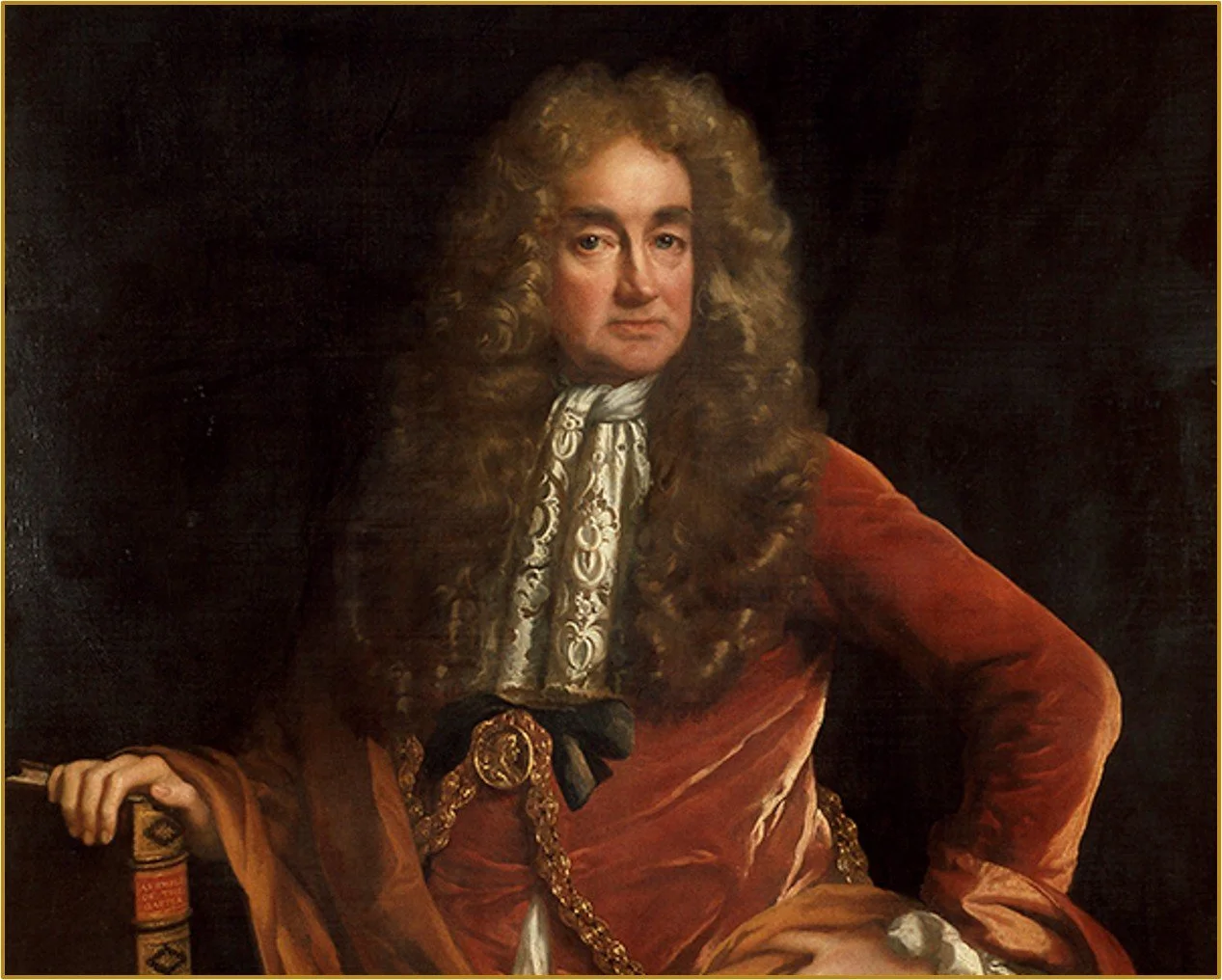
Figure 6: Elias Ashmole (1617–1692): Royal Society Fellow, early speculative Freemason, and avid collector of esoteric antiquities during an era of intense political and religious unrest.
From Invisible College to The Royal Society of London
With the Restoration of King Charles II to the English throne in May 1660, the period of political instability drew to a close. On November 28 1660, following a lecture by astronomer Christopher Wren at Gresham College, a group of twelve natural philosophers, including Wilkins, Moray, Boyle, Petty, Wren, and Brouncker, met in a committee room to formalise their association (RoyalSociety.org, 2026).
Sir Robert Moray brought the initial proposal to King Charles II, who approved the scheme. On July 15 1662, the King granted the first formal Royal Charter, officially creating The Royal Society. A Second Royal Charter, passed under the Royal Seal on April 22 1663, changed its official name to The Royal Society of London for Improving Natural Knowledge (Lomas, 2012, p. 166), (RoyalSociety.org, 2026).
The newly formed Royal Society immediately adopted principles that would appear to mirror both Baconian philosophy and Masonic lodge etiquette:
Banning Religion and Politics
To prevent the ideological schisms that had destroyed the nation during the Civil War, the Society enacted a strict rule: all discussions of sectarian theology and state politics were forbidden at their assemblies. The focus was restricted to experimental inquiries and the study of nature (Syfret, 1948, p. 85).
Nullius in Verba
The motto adopted by the Royal Society, Nullius in Verba (English: Take no one’s word for it), was adopted shortly after their foundation (RoyalSociety.org, 2026) and expressed their commitment to empirical proof over dogmatic authority. No claim, regardless of the antiquity or status of its author, was accepted without experimental verification.
Demystification of the Natural World
One of the iconic early demonstrations of The Royal Society occurred when members tested a long-standing medieval legend that a spider could not escape from a circle drawn with powdered unicorn’s horn (Lomas, 2012, pp. 158-159). When the ring was drawn, a spider was placed in its centre. Curiously, the spider, rather than being trapped within the ring, simply walked straight out uncaring for the ring’s mythical properties. This symbolical demonstration was used to suggest an epistemological shift where empirical observation had now triumphed over beliefs of fancy. However, it would have been interesting to observe if the results of this demonstration would be repeatable if they used real unicorn horn, rather than that of a white rhinoceros.
The Institutionalisation of Scientific Publishing
In 1665, under the leadership of Secretary Henry Oldenburg, the Society established Philosophical Transactions. As the world’s first peer-reviewed journal dedicated exclusively to science, it actualised Bacon’s ideal of sharing “patterns of experiments[5]” openly across international boundaries, establishing the modern scientific paper as the standard unit of knowledge transmission.
Lessons for Contemporary Freemasonry: Building Utopia Within Modern Chaos
Some commentators today might lament the downfall of society’s perception of academic institutions in western society. Why can’t society today just treat scientists and educators like Kings, as were the Father’s of King Salomon’s House in the The New Atlantis? Why can’t we look up to our educators and scientists as figures of authority as we did with the pioneers of The Royal Society. If only people today could look to reason, perhaps they might be less inclined towards looking at our scientific and educational institutions with disdain and reinstate them as the authorities they ought to be?
It could be possible to finalise this paper with a simple lament and appeal. But alas, that is not this author’s viewpoint. My belief is that in the future we will look back at our current state of technological advancement as a dark age. This is not due to a lack of innovation, which is surely progressing. But as we enter into our own increasingly A.I. powered current age, we find ourselves holding a question that currently remains unanswered: What becomes of humanity when technological power outpaces humanity’s moral and spiritual evolution?
As such, I think it may be time for a new instauration: A new New Atlantis.
But my sphere of influence is not so vast as to change the world. And I am not as educated as those great minds of The Royal Society. Nevertheless, I can hopefully still appeal to Freemasons reading this to affect a change in the mind of a Brother.
The transformation of The Invisible College into The Royal Society offers some great historical, philosophical, and structural lessons for contemporary Freemasons. Today's world, much like that of seventeenth century England, is plagued by intense polarisation, ideological echo-chambers, rapid technological shifts, and a decay in civil discourse. Our own public discourse is a disarray of so-called woke leftists and Nazi right-wingers. The Craft today exists within a very challenging cultural landscape. Will we succumb to defeat and retreat into isolated echo-chambers? Will we establish our own lodges and restrict membership only to those men who share our own political leanings? Or will we bravely face this new world and open ourselves up to pursuing the summum bonum, despite our differences?
Fortunately, if we do decide to take the high-road, then we may take solace in the fact that not only have Freemasons of different political persuasions worked side-by-side before, but that, at least in one instance, their shared vision laid the foundation for one of the greatest civilisational revivals in human history: the foundation of The Royal Society.
So what lessons might we draw from our ancestors?
Lesson 1: The Preservation of the Lodge as a Sacred Sanctuary of Neutrality
In my opinion, one of the primary breakthroughs of the founders of The Invisible College was their recognition that intellectual and spiritual progress requires a neutral space. By explicitly banning politics and religion from their meetings, they created an environment where Royalists and Parliamentarians could meet on the level.
In our own cultural milieu where political and social discourse is increasingly polarised, Freemasonry must fiercely safeguard its traditional prohibition against political and sectarian religious promotion within the Lodge. The Lodge must not become an arena for contemporary culture wars. It must remain a sacred sanctuary where men of all political persuasions, religious beliefs, and background demographics can sit down in harmony, united by shared moral obligations and a common and sincere search for truth.
Lesson 2: The Triumph of Reason Over Emotional Dogma
The founders of The Invisible College observed how unchecked emotional fanaticism disguised as religious purity or political loyalty had laid waste to their nation. They responded by exalting reason and mutual respect over disharmony.
Masons are repeatedly charged in their ceremonies to cultivate the cardinal virtue of Prudence. This is not meant to be easy. We have challenges that our forefathers did not. We have social media algorithms which are designed to outrage, spread misinformation, and incite emotional division. But we as Freemasons must act as a stabilising force within society. A Freemason should be characterised by an even-tempered, analytical mind. We must continually test our assertions, reject dogma, and exercise tolerance. This means that we must listen to open discussion on topics we find uncomfortable without feeling the need to inject ourselves into the discussions perceiving ourselves as being representative of a superior motive.
Lesson 3: Reclaiming the “Hidden Mysteries of Nature and Science”
“I shall content myself with observing that, as in the former degree you were made acquainted with the principles of moral truth and virtue, you are now expected to extend your researches into the hidden mysteries of nature and science.”
There are many wonderful lessons we are given in the Craft. And within the Fellowcraft degree there is a special emphasis on the investigation of the “hidden mysteries of nature and science.” Naturally, this is a study of birth, life, death, and all that between them manifests.
In my opinion, Lodges should actively reclaim their heritage as centres of education, philosophy, and inquiry. The work we do here in the Lodge of Research is wonderful. But I think we can all agree that much of what we do here ought to be within the domain of a regular Craft Lodge. Unfortunately, much of what we achieve here is but picking up the slack.
Does this mean that brethren should be encouraged to be professional lecturers and present research papers on science, history, and ethics? No! To Know Thyself, a Freemason must actively seek to understand those relationships which exist between, Man, Nature, and God, and understand the laws which sustain our universe. Whilst a lecture achieves this, a simple discussion, recital of catechisms, contemplation of rituals, and many other activities, all achieve this as well. We do not need more Masonic dorks like myself standing up and giving a lecture. We simply need good hearty contemplative discussion.
Lesson 4: Transitioning from Solitary Improvement to Collaborative Fellowship
The ultimate failure of alchemy lay in its solitary nature. The belief that enlightenment was a private treasure to be hidden away is folly. For a Rosicrucian philosopher, enlightenment is not to be found on a mountaintop, but in life. A part of the success of The Invisible College lay in its shift toward collaborative utility. The Light once discovered must be used for the improvement of human society.
Personal self-improvement (taking a rough ashlar and making it smooth) is only the first phase of Freemasonry. The ultimate purpose of smoothing that ashlar is to fit it into a larger structure. This is the collective temple of humanity. And I think this is why Boyle placed such emphasis on The Invisible College as having had as their central concern the well-being of all humanity. So, our next step, after establishing a contemplative Lodge culture is to ask ourselves: Is our Masonic knowledge helpful when it remains siloed within our Lodge? Or is it being translated into tangible service to others? Masonry must not become an insular club; it must be an active engine for societal harmony and enlightenment.
So let’s get moving! Let’s build a Masonic Library! Let’s build a Centre for Masonic Excellence! Let’s refine and advance our educational curriculum! Let us become the wise-men that people seek out for knowledge; that many Masonic institutions but only vainly parody.
Lesson 5: Prioritising Things, Not Words (Nullius in Verba)
The Royal Society achieved its renown because it rejected hollow rhetoric and demanded demonstrable results. In other words, focusing on things, not words.
Contemporary Freemasonry must beware the trap of relying solely on impressive titles, elaborate regalia, and archaic terminology while failing to produce any meaningful results. The world no longer judges the Craft by its claims of ancient wisdom. We can no longer hold out that we have some mystical secret in some chamber unknown. This does not work any more. This novelty has worn off! We are being judged by our character, integrity, and actions. Do the words of a Brother wearing the darkest of blues and studded with the most shiniest of jewels, mean more than that of a Brother of a humbler station? I’ve been fortunate enough in my life to meet some incredibly wise men and women. And the thing that stands out the most about them is just how regular they look. You would not pick them out in the street.
Freemasons must live their philosophy in their daily lives, and demonstrate Masonic teachings through action. Whether we like this or not, this is what is being judged. How many of you have met a brother who left the craft because of the behaviour of another believed to be of a superior position? Ought this have been prevented by a proper understanding that rank is just an indicator of responsibility and only symbolic of any moral or ethical attainment?
All of the above requires us to have faith in our Masonic principles and a trust that aspiring and working towards greatness will lead us to a better station. A station which will also demand of us greater service.
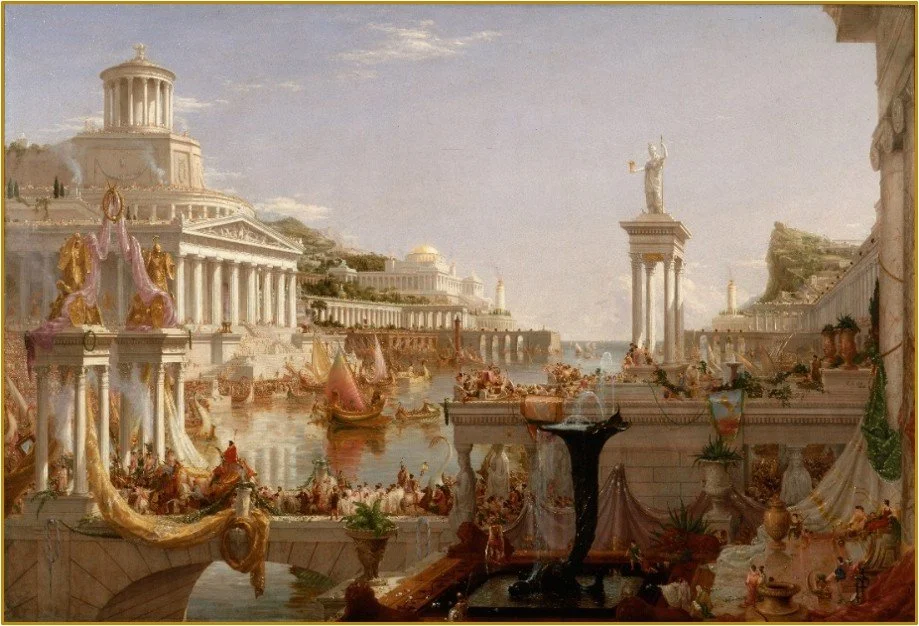
Figure 7: The third painting in Thomas Cole’s The Course of Empire series captures civilisation at its peak. Look closely, and you'll see that the rise and fall of civilisation is built upon everyday human interactions.
Conclusion
The story of The Invisible College is fundamentally a story of hope amidst collapse. Out of the ashes of the English Civil Wars, a small group of courageous political and religious refugees chose to abandon the dogmas of their age and journey together towards a utopian ideal. And yet, each of these men had their own identity. Each one could have a Masonic paper written solely about their own biography. And this is where I like to think that I differ from other idealistic Masonic/Rosicrucian writers. I do not think that utopia is an ideal we should strive for. In fact, I daresay our sphere of influence is limited; quite possibly far more limited than we might wish to imagine. And yet, I still think that we as individuals are capable of great things. But we may need to shift our thinking as to what our definition of great might be. I don’t think many today give much thought to just how paradigm-changing this small group of men were. And yet their decisions were quite small. They were men of principles, working together with mutual respect. And together, they summoned a spirit of influence that helped change the world forever.
Utopia begins at home. It begins with us as individuals. Let us take the learnings and inspirations we gather here in The Victorian Masonic Lodge of Research with us, not to affect change in a Grand Lodge, but in our own Lodges.
Let us maintain our Lodges as a sanctuary of peace, a champion of reason, and a beacon of intellectual light, so that when chaos calls (and it will) we will have already sought, built, and realised a philosophical college in which to call home.
References
Bacon, F. (1626/2020). The New Atlantis. Edited by Gerard B. Wegemer. Dallas: CTMS Publishers at the University of Dallas.
Bacon, F. (1876 (Original work published 1605)). The advancement of learning. London: Clarendon Press.
Bacon, F. (1902). Novum Organum. (M. Joseph Devy, Ed.) New York: P. F. Collier & Son.
Boyle, R. (1744). The Works of the Honourable Robert Boyle (Vol. 1). London: Printed for A Millar, opposite Catharine-Street, in the Strand.
Held, F. E. (1914). Johann Valentin Andreae's Christianopolis- And ideal state of the seventeenth century. Illinois: University of Illinois.
Hunter, M., Clericuzio, A., & Principe, L. M. (2016). The Correspondence of Robert Boyle. Volume 1. 1636-61. Introduction. New York: Routledge.
Lomas, R. (2012). The Invisible College: The Royal Society, Freemasonry and the Birth of Modern Science. Fair Winds Press.
Price, D. d., & Beaver, D. d. (1966). Collaboration in an Invisible College. American Psychologist, 21(11), 1011-1018.
Purver, M. (1967). The Royal Society: Concept and creation. London & New York: Routledge.
RoyalSociety.org. (2026). History of The Royal Society. Retrieved from royalsociety.org: https://royalsociety.org/about-us/who-we-are/history/
Sprat, T. (1667). The History of the Institution, Design, and Progress of The Royal Society of London, for the advancement of experimental philosophy. The First Part. London: wikisource.org. Retrieved from https://en.wikisource.org/wiki/The_History_of_the_Royal_Society_of_London/Part_1
Syfret, R. H. (1948). The origins of the Royal Society. Notes and Records of the Royal Society of London, 75–137.
Webster, C. (1975). The Great Instauration: Science, Medicine and Reform 1626-1660. New York: Holmes & Meier Publishers.
[1] This first Rosicrucian source work would be published in 1614 with the full name General Reformation of the whole wide world besides the Fama Fraternitatis or Brotherhood of the Highly Praiseworthy Order of the R.C. To the Heads, estates and scholars of Europe.
[2] Masonic and Rosicrucian authors often incorrectly refer to these as the three Rosicrucian manifestoes. Despite this, they were not manifestoes, nor were they limited to three. For a further elaboration, see The Rosicrucian Compendium published by Temple & Vault Press.
[3] One can see here a similarity with the second rule of the Rosicrucian brotherhood, as presented within the Fama Fraternitatis: None of the posterity should be constrained to wear one kind of habit, but to follow the custom of the country.
[4] The period in English history between the execution of King Charles I in January 1649 and the Restoration of King Charles II to the throne in May 1660. It was not until after the interregnum that the members of this informal group would receive royal patronage and an official charter from King Charles II in 1662, officially formalising the group into The Royal Society of London.
[5] “These are, my son, the riches of Salomon’s House. For the several employments and offices of our fellows, we have twelve that sail into foreign countries under the names of other nations (for our own we conceal); who bring us the books, and abstracts, and patterns of experiments of all other parts. These we call Merchants of Light (Bacon, 1626/2020, p. 40).”