The Real Meaning of Rosicrucianism: Lineage or Community

Researching and writing The Rosicrucian Compendium has brought so many wonderful friends and unforgettable experiences into my life. I wanted to take a moment here to share a few of my favourite conversations with readers.
My journey as an esoteric author is still in its infancy. I’ve only written two books and write for a very niche audience. If I were to judge my success solely by book sales, I’d probably be considered a failure! I certainly haven't broken any records or topped any bestseller lists.
But what I am absolutely blessed to have gained is a small group of highly perceptive, sincere readers. This manifests itself in some deep, powerful conversations rather than a multitude of comments or reviews. And to be honest, I love it this way. There are many struggling authors who cannot even get their books sold, let alone read. So to converse with people who have sincerely read and engaged with my work truly is an honour. In many cases, these conversations also show me that I have been successful in presenting my message. For this, I am immensely grateful.
In this piece, I wish to present to you two comments I have received from readers that have brought me an immense feeling of satisfaction as a writer.
A utopia with a small "u"
Recently, I was told by a reader of The Rosicrucian Compendium that the book seems to promote the idea of a utopia with a small “u”.
Perhaps this might seem like an odd comment, but I at once understood exactly what the reader meant, and I was so appreciative of his insight. If he were standing in front of me, I would have given him a fist-bump!
The Rosicrucian Pulse
The idea of reformation is central to the Rosicrucian tradition. The tradition has always operated with a cyclical pulse. When the night of human progress is at its darkest hour, the metaphorical tomb of CRC is re-opened, the Brotherhood reconstitutes itself, and society enters into a new period of societal advancement. It is for this reason that some Rosicrucian authors have placed the birthdate of Christian Rosenkreuz well before the source work era of the seventeenth century. Some authors will align the birth of the Rosicrucian tradition with a primordial impulse that has existed from the dawn of time. Some will align it with a notable Pharaoh, King, or leader. And others have provided a birthdate at the dawn of the Renaissance so as to suggest a formative Rosicrucian influence on that era. It is easy to perceive just what these authors were trying to represent: Rosicrucianism arises when humanity needs it most, initiating a period of advancement.
This hallmark of the tradition arose with the Fama Fraternitatis in Germany in 1614. It was here that we actually get the name Rosicrucian, taken from the name of the Brotherhood established by CRC in the text, The Fraternity of the Rosy Cross (German: Orden des Rosenkreuzes). During this era, the Rosicrucian wisdom found within CRC’s tomb was seen as heralding in a new age. This was hoped to bring forth a rectification of both society and man. In other words, it was grandly utopian.
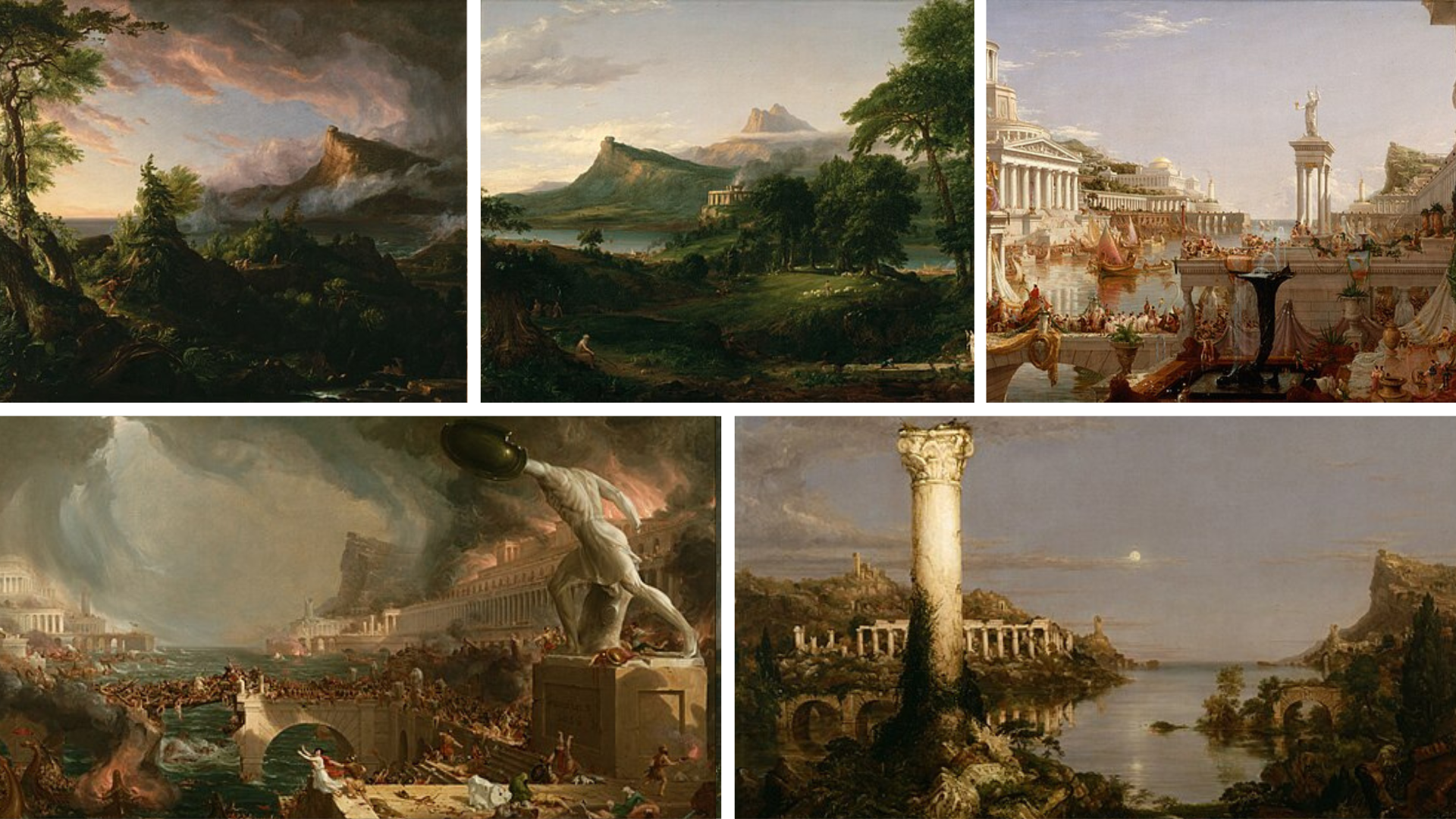
Just as the sun must set after its zenith, civilisations inevitably reach a point where their momentum slows. Internal divisions, complacency, or overextension erode their foundations. External pressures, such as invasions, economic shifts, or environmental changes, further destabilise them. In time, the once-mighty empire wanes, leaving behind only ruins and lessons for future generations. And the same is true for Rosicrucian organisations. This phenomenon was illustrated remarkably by the English-born American painter, Thomas Cole (1801-1848) in his series of paintings entitled, The Course of Empire, which illustrates beautifully the transitory and cyclical nature of human achievements.
And whilst we do not exactly know who was behind this movement, some of the most likely candidates and influencers had themselves dabbled in utopian fiction, such as Johannes Valentinus Andreae’s Christianopolis and Francis Bacon’s The New Atlantis.
As the centuries have progressed, various Rosicrucian fraternal movements have arisen that also indulged in such apocalyptic tendencies. Such a vast vision for humanity often brings with it, at its best, certain feelings of compassion for humanity, and when it is at its worst, feelings of grandiosity and superiority.
Oftentimes, this can manifest as a glaring contradiction whereby sincere Rosicrucian philosophers wish to change the world, meditate for peace, metaphysically influence the decisions of the world’s decision-makers, whilst at the same time being barely able to master the elementary social tendencies that arise during the course of simple group work. And whilst I do think that human potential is far greater than many are generally aware of and that our human faculties have a tremendous potential, I also think that peace begins at home. If you want peace in the world, start with your own surroundings. At the end of the day, Rosicrucianism is a practical tradition, and these values must be put into practice.
So then imagine how happy I was when a reader acknowledged that the Compendium seems to promote the idea of a utopia with a small ‘u’?
I’m sure every author attempts to find novel ways to differentiate their books from the crowd. And the Compendium was no different. It has multiple unusual ways of communicating and suggesting Rosicrucian values to the reader.
The final chapter of the book incorporates several of these novel devices. One of the more subtle was located in a sub-chapter on Rosicrucian Community. This section introduced a subtle directive: assume the role and responsibility of a Rosicrucian Master right now. Don't wait for the stars to align. Live as if you already carry the quiet responsibility of the Rosy Cross within you. It seemed like a perfect culmination after some of the previous discussions of Rosicrucian Masters and the Invisible Fraternity. But I must say, this section was inspired by another mystical work.
The Jig is up! “Have you read ‘The Conference of Birds’?”
One eagle-eyed reader did approach me on Instagram and recognised a similarity between this chapter and the famous Persian poem, The Conference of the Birds by Sufi poet Farid ud-Din Attar. Ah, the jig is up! He was 100% correct. I did take inspiration from this remarkable poem when drafting this chapter.
So what is The Conference of the Birds, and why did I incorporate its themes into my section on Rosicrucian Community?
The Conference of the Birds is an alchemical-mystical Persian poem. The narrative begins with a gathering of the world's birds. Though they belong to the same kingdom, they are completely disjointed, separated not just by their species but by their individual flaws, neuroses, and worldly attachments. Realising their collective state of aimlessness and disorder, they recognise the need for a sovereign who might unite them and bring order to their lives.
A collective awakening occurs when a single feather falls from the heavens. This feather belonged to the legendary Simorgh, a mythical bird of Persian lore (imagine a giant peacock-like Persian Phoenix, and you will be on track). Driven by a deep sense of their own inadequacy and inspired by this divine sign, the birds decide to seek out the Simorgh to be their King. However, the Simorgh is no ordinary creature; he lives atop the distant, sacred Mount Qaf. To reach him, the birds must cross seven treacherous, soul-testing valleys.
Leading the expedition is the wise and courageous Hoopoe (a crested lapwing bird), who acts as their spiritual guide. The journey is daunting, and many birds initially offer excuses to avoid leaving their comfort zones. For instance, the Nightingale refuses to leave because it is hopelessly infatuated with the transient beauty of the rose. The Parrot prefers the safety of a golden cage to the perils of the unknown. The Peacock laments its removal from Paradise and wishes only to return there. The Duck refuses to leave the security of the water, claiming it cannot survive on dry land. The Hawk is content with its prestige and high status at the court of human kings.
To each objection, the Hoopoe offers wisdom and counsel, encouraging them to see past their individual weaknesses and to actually point out their strengths that will be required for the arduous trek. While thousands of birds ultimately set flight, the gruelling journey across the seven valleys claims the vast majority through exhaustion, hunger, and temptation.
In the end, only thirty brave birds survive to enter the kingdom of the Simorgh. As they fly towards their summit, they look down, expecting to see their magnificent new King. Instead, they see their own reflection. It is here that the author delivers a profound linguistic and mystical revelation to the reader. You see, in Persian, Si means thirty, and morgh means bird. The Simorgh is literally the si morgh (the thirty birds). Through their own fortitude and courage, the birds completed their journey and discovered that the ultimate truth they sought was within them all along.
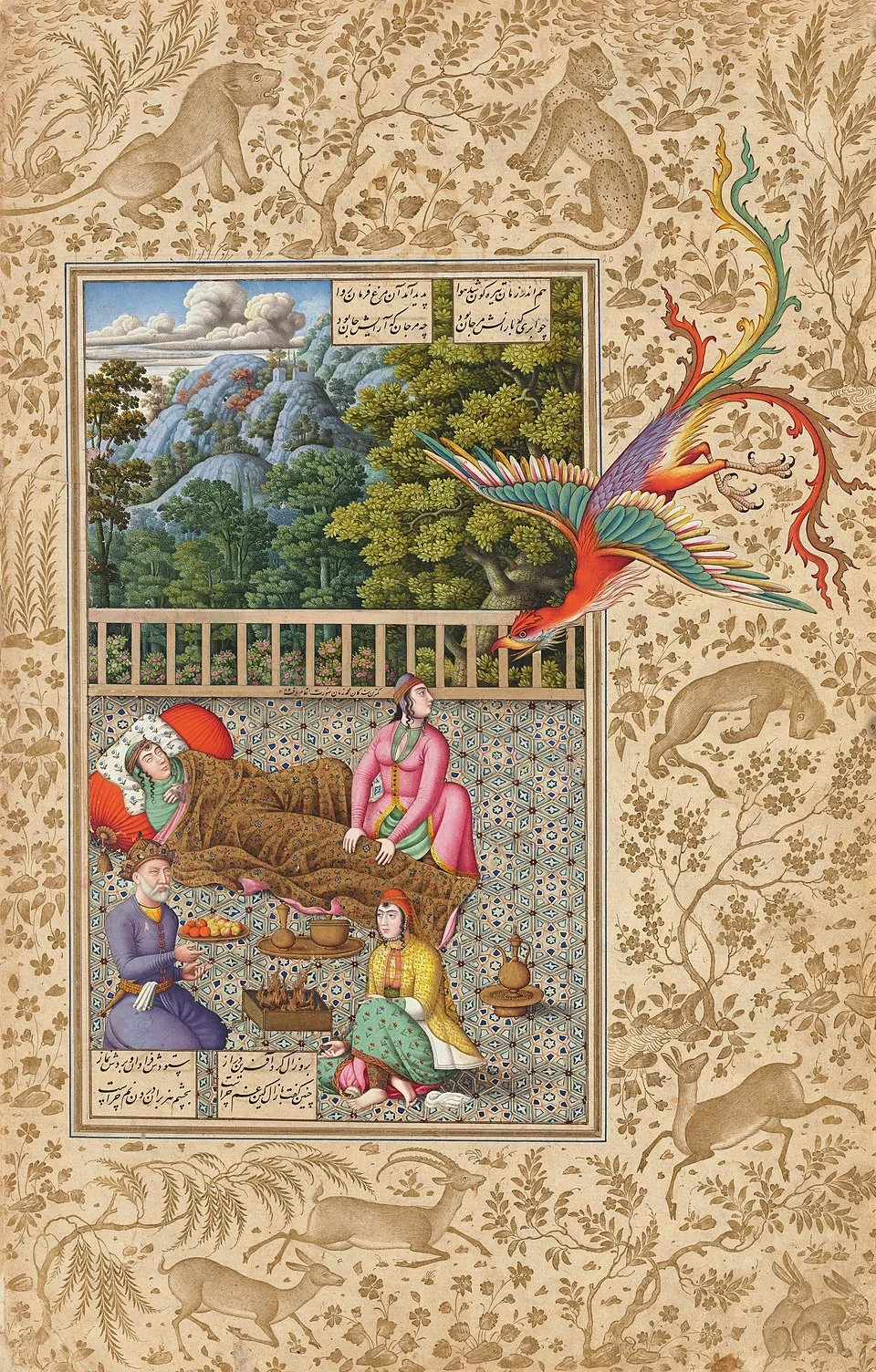
This image is from a scene in the Persian legendary epic, Shahnameh. It depicts the Simorgh sweeping in to instruct the father on how to safely surgically deliver his son during a troublesome birth. This is actually the first known depiction of a caesarean section. Fortunately, both mother and son survive the procedure.
Finding the Rosy Cross within
There are many themes here that resonate with a Rosicrucian group. How many Neophytes knock upon the portal actually end up completing their initiatic quest? Both figuratively and literally.
It was this message that I wanted to suggest in the final chapter of the Compendium. The real Rosicrucian Order is that which we become by the sincere effort of our own work.
This is not a new concept. Disney has built its empire upon instructing children that the real magic is within us to begin with. But somewhere along the line, Rosicrucian students appear to have forgotten this message. They obsess over external validation. They look for lineages. For example, a Rosicrucian organisation might be deemed as inauthentic because it does not have a lineal descent. But a lineal descent to what? To the unknown writers of the Fama Fraternitatis? Do you think these writers prized an apostolic-style succession in this tradition? Another distraction has been to identify a Rosicrucian organisation as authentic by how it might meet certain arbitrary criteria, usually selected from the laws of the Fraternity of the Rosy Cross as outlined in the Fama Fraternitatis. But looking to the Fama Fraternitatis as some barometer of recognition is akin to the Zen proverb where the wise man points out the moon, but the ignorant student looks at the finger. The Fama Fraternitatis does describe the underlying values of Rosicrucianism, but seeking to identify something as Rosicrucian by measuring it against a set of arbitrary criteria is a recipe for failure. These misunderstandings become obstacles to our recognising the living Rosicrucian spirit active around us.
And yet, how many times have we experienced the Rosicrucian spirit arise within a group of sincere students? It’s not complicated. When Shakespeare’s Juliet says, a Rose by any other name would smell as sweet, she was able to intuit the reality of love, even if it did not conform to the demands of the world around her. When we come together, we can invoke this spirit. It can happen in a lodge. It can happen in a temple. It can happen at someone’s home. You might be surprised at just how a group of sincere seekers may be assisted when they unite together in purpose.
Does this mean that Rosicrucian organisations do not have lineages? No, not at all. In fact, I’m familiar with Rosicrucian organisations that do have lineages that do appear to transfer certain inheritances. But these lineages are unique to those traditions and don’t necessarily make something more or less Rosicrucian. It just makes that organisation an authentic inheritor of its own unique tradition.
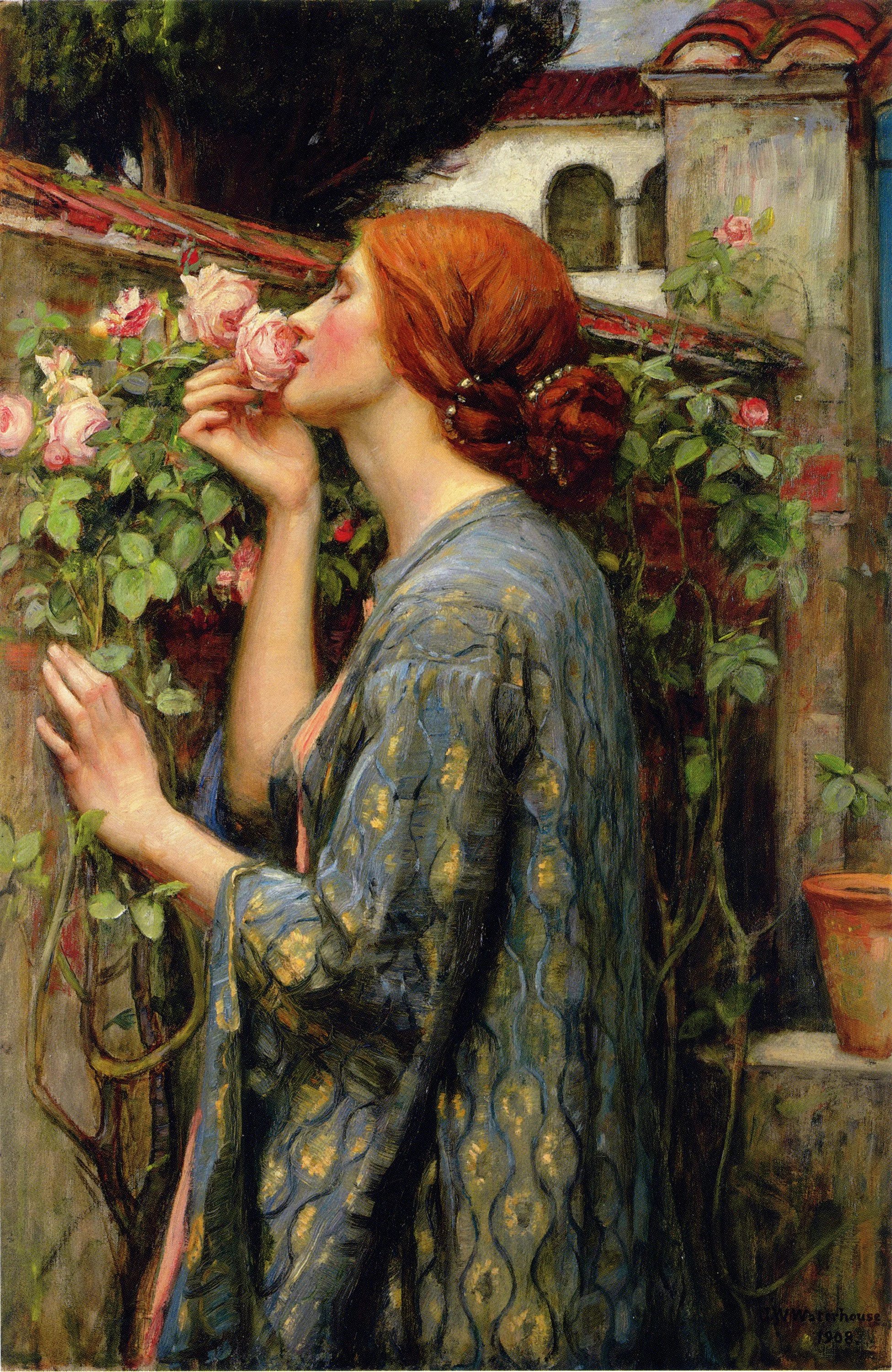
“The Soul of the Rose” (1903) by John William Waterhouse. I really love this image!